Projects
Research
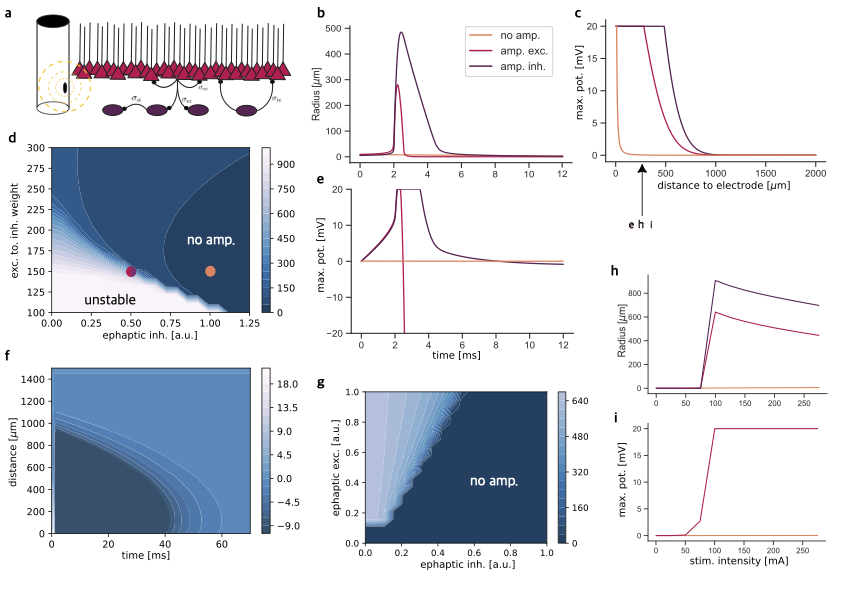
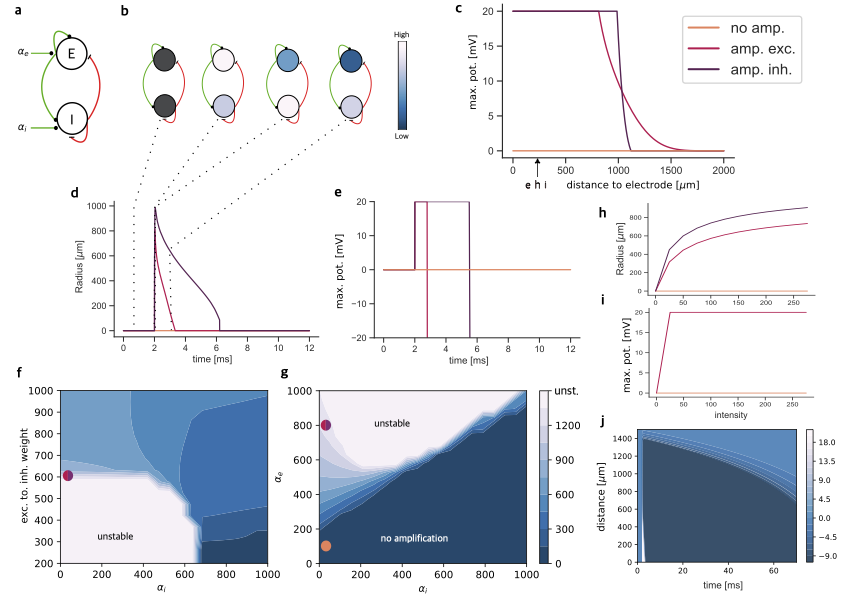
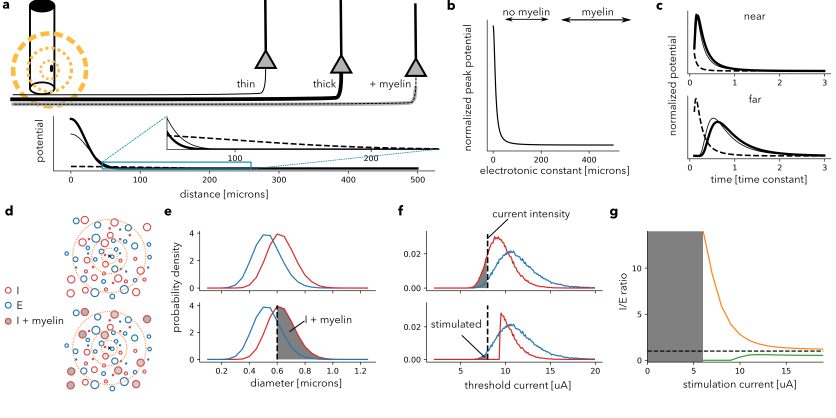
MSc thesis investigating how excitatory and inhibitory cable properties control the transient amplification of network responses to electrical stimulation, under Prof. Richard Naud at the University of Ottawa.
Overview
Microstim is a scientific Python package for simulating and analyzing axonal and cellular responses to electrical stimulation. It models how neural cortical tissue responds to intracortical microstimulation (ICMS), exploring the role of excitatory/inhibitory balance in shaping network dynamics.
Key Figures
Approach
- Cellular and axonal models — simulate both cell bodies and axon responses using customizable parameters and YAML-driven configuration
- Transient amplification — quantifies how E/I cable properties boost short-lived network responses to point stimulation
- Publication-ready output — automated generation of heatmaps, radii plots, intensity maps, and animations
- CLI-driven — any analysis or figure can be launched from the command line with flexible flags
Computational study exploring ion homeostasis in spatially polarized excitable cells, with an approach to maximize endogenous electric fields through symmetry breaking.
Abstract
Understanding the dynamics of ion flux and polarization in spatially polarized excitable cells is crucial for fundamental physiological processes such as wound healing, muscle contraction, and nerve impulse transmission.
This study investigates a charge difference model as a two-compartmentalized cell connected by a gap junction. Through theoretical analyses and simulations, we explore the result of symmetry breaking by manipulating ion permeability ratios and elongating the cell on endogenous electric fields.
Our findings reveal that symmetry breaking can significantly enhance endogenous electric field strength while staying within realistic constraints, providing insights into cellular polarization mechanisms and implications for future research in cell physiology.
Model
Methods
- Two-compartment model — cells represented as two electrically coupled compartments connected via a gap junction
- Symmetry breaking — ion permeability ratios manipulated to break geometric symmetry and amplify field strength
- Parameter sweeps — Python simulations over permeability and geometry to identify field-maximizing regimes
Software
Currently in development. More details coming soon.
A browser extension for tracking personal progress on arithmetic.zetamac.com — logging response times, corrections, and building a persistent heatmap of performance over time.
The Problem
Zetamac gives you a final score but nothing else — you don't know which problems slowed you down, which you had to correct, or whether you're improving at specific combinations over time.
What it does
- Per-session results — response time per problem, avg/fastest/slowest, correction count
- Session heatmap — one square per problem, diverging color scale centered on your session mean. Darker green = faster, darker red = slower, dot = backspace used
- Persistent history heatmap — a full multiplication and addition grid that accumulates across all sessions so you can see long-term patterns
All data lives in chrome.storage.local — no account, no server.